
Whether you’re a tenant trying to understand if your landlord’s notice is valid, or you’re trying to figure out how to legally terminate a tenancy contract in Dubai, terminating a tenancy in Dubai isn’t as simple as just moving out or asking someone to leave. The process is tightly regulated under Dubai’s tenancy law, and getting it wrong — on either side — can mean financial penalties or a rejected case at the Rental Disputes Centre. Here’s exactly how it works.
New to Dubai’s rental system? Start with our companion guide on Tenant Rights in Dubai — What RERA Actually Says for the broader legal context before diving into termination specifics.
The Legal Basis
Termination and eviction in Dubai are governed by Law No. 26 of 2007 (as amended by Law No. 33 of 2008) and Decree No. 43 of 2013, all enforced by RERA and the Dubai Land Department. The core principle: a tenancy in Dubai is not “at will.” Even when a landlord has a legitimate reason to end a lease, they must follow a defined legal process — and the difference between a valid termination and an unlawful one almost always comes down to whether the correct notice period and delivery method were used.
Valid Grounds for a Landlord to Terminate
A landlord cannot end a tenancy simply because they’ve found a higher-paying tenant or changed their mind. The law recognizes only specific grounds:
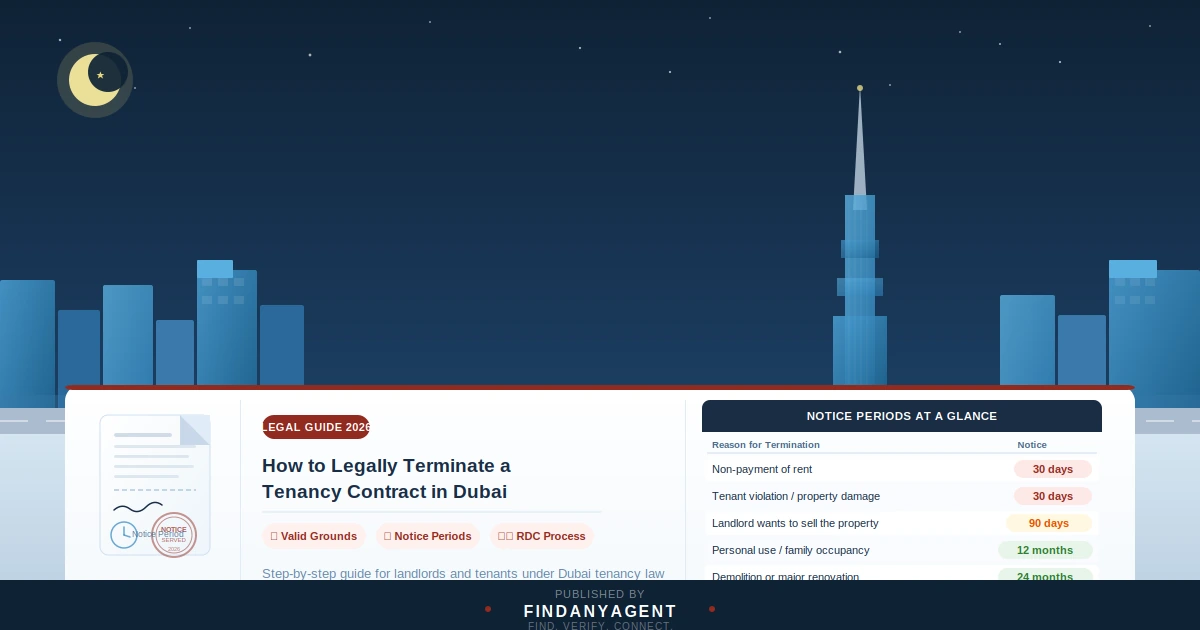
| Reason | Required Notice |
|---|---|
| Non-payment of rent (after a 30-day written demand) | 30 days |
| Tenant violation (illegal use, property damage) | 30 days |
| Landlord wants to sell the property | 90 days |
| Landlord wants to occupy the property personally (or a first-degree relative) | 12 months |
| Major renovation or demolition | 24 months |
Two of these deserve closer attention because they’re the most commonly misused — and the most commonly challenged at the RDC.
Personal Use Eviction
If your landlord wants the property back for themselves or an immediate family member, they must:
- Provide 12 months’ written notice, delivered via notary public or registered mail — a WhatsApp message, email, or phone call does not satisfy this requirement.
- Specify exactly which family member will occupy the unit and their relationship to the landlord.
- Not re-list the property for rent for at least 12 months after the tenant vacates. If they do, the former tenant can file a compensation claim — potentially up to one year’s rent.
- If the landlord owns multiple properties, simply preferring this one isn’t sufficient grounds; they may be required to justify why this specific unit is needed.
Renovation or Demolition Eviction
As of 2026 regulatory updates, this now requires 24 months’ notice (up from the previous 12), along with documented municipal permits proving the renovation or demolition is genuine — closing a loophole landlords previously used to fast-track evictions in high-demand buildings under the guise of “renovation.”
What Tenants Can Do to End a Lease
Tenants have more flexibility than landlords in some respects, but early termination is still governed by what’s written in your tenancy contract:
- At natural contract expiry: if you simply don’t wish to renew, you generally aren’t required to provide the same lengthy notice landlords must give — but check your contract for any specific notice clause (commonly 60–90 days).
- Early termination before the contract ends: this depends entirely on your contract terms. Many Dubai tenancy contracts include an early termination clause specifying a penalty (often equivalent to one to two months’ rent) if you break the lease before its term ends. If your contract is silent on this, early termination without landlord agreement can expose you to a claim for the remaining contract value.
- Non-payment by the landlord of agreed services or major maintenance failures: in cases of serious landlord breach (failure to maintain habitability, for example), tenants may have grounds to terminate or seek RDC intervention — but this generally requires documented written notice to the landlord first and a reasonable opportunity to remedy the issue.
What Makes a Termination Notice Invalid
If you’re a tenant facing a termination notice, check it against these requirements before assuming you have to comply:
- Wrong delivery method. Notices must go through notary public or registered mail. Text messages, verbal notice, or informal emails generally don’t meet the legal bar for eviction-related notices.
- Insufficient notice period. Compare the notice you received against the table above. A 30-day notice for a “personal use” eviction, for example, is invalid — that requires 12 months.
- Vague or unsubstantiated grounds. A notice that says “I want my apartment back” without specifying the legal ground and required details (e.g., which relative, what renovation permit) can be challenged.
- Retaliatory timing. If a termination notice arrives shortly after you’ve filed a maintenance complaint or rent dispute, this pattern itself can be relevant evidence in a retaliation claim.
Self-Help Eviction Is Illegal
This is worth stating plainly: a landlord cannot change your locks, disconnect your utilities, remove your belongings, or otherwise force you out without going through the formal legal process — regardless of how legitimate their underlying reason might be. Attempting this exposes the landlord to legal and potentially criminal liability, and gives the tenant immediate grounds for an RDC complaint.
The Termination Dispute Process
If you believe a termination notice is invalid, or if you’re a landlord whose tenant won’t vacate after a lawful, properly served notice:
- Document the notice — keep the original, the delivery method used, and the date received.
- Attempt direct resolution — a single documented written communication attempting to resolve the matter is typically expected before filing.
- File with the Rental Disputes Centre (RDC) — via the DLD website, the Dubai REST app, or in person in Deira. The filing fee is generally 3.5% of annual rent (minimum AED 500, maximum AED 20,000).
- Attend the hearing — many RDC hearings can now be conducted remotely, and straightforward cases are often resolved within two to four weeks.
For full background on the rights underpinning this process — rent caps, deposit rules, and your protections during an active tenancy — see our companion piece: Tenant Rights in Dubai — What RERA Actually Says.
Quick Checklist Before You Act
If you’re a landlord planning to terminate:
- Confirm your reason matches one of the legally recognized grounds
- Calculate the correct notice period for that ground
- Deliver notice via notary public or registered mail — keep proof
- If citing personal use or renovation, gather the required supporting documentation
If you’re a tenant who received a notice:
- Check the notice period against the legal minimum for the stated reason
- Confirm it was delivered via a valid legal channel
- Keep copies of everything
- If anything looks off, consult RERA or file with the RDC before vacating
This article is for general informational purposes and does not constitute legal advice. Dubai’s rental regulations are periodically updated — always verify current requirements via the Dubai Land Department, RERA, or a licensed legal professional before acting on a termination notice, whether you’re issuing or receiving one. Need help finding a property or a trusted legal advisor in Dubai? Browse verified agents and legal service providers on FindAnyAgent.