Renting in Dubai can feel intimidating if you’re new to the city — contracts, deposits, Ejari, rent increases, and the looming question of “what happens if my landlord wants me out?” The good news: Dubai has one of the more structured rental markets in the region, and as a tenant, you have real, enforceable rights under the law. Here’s what RERA actually says, about Tenant Rights in Dubai, in plain English.
The Legal Framework
Dubai’s rental relationships are governed by Law No. 26 of 2007, as amended by Law No. 33 of 2008 — collectively known as the Dubai Tenancy Law. This is enforced by RERA (the Real Estate Regulatory Agency), which operates under the Dubai Land Department (DLD). Unlike many cities where landlord-tenant issues get sorted out informally, Dubai has a dedicated tribunal — the Rental Disputes Centre (RDC) — built specifically to handle these cases, and it tends to move quickly and favor whichever party followed the proper legal process.
1. Your Right to a Registered Contract (Ejari)
Every tenancy contract in Dubai — residential or commercial — must be registered through Ejari. This isn’t a bureaucratic formality; it’s the foundation of your legal standing as a tenant. Without it:
- You have no legal standing to file a complaint with the RDC
- You can’t set up a DEWA (electricity and water) connection in your name
- Many visa applications and renewals tied to your residence will be blocked
If your landlord refuses or delays registering your contract, you can file a complaint directly with RERA.
2. Protection Against Excessive Rent Increases
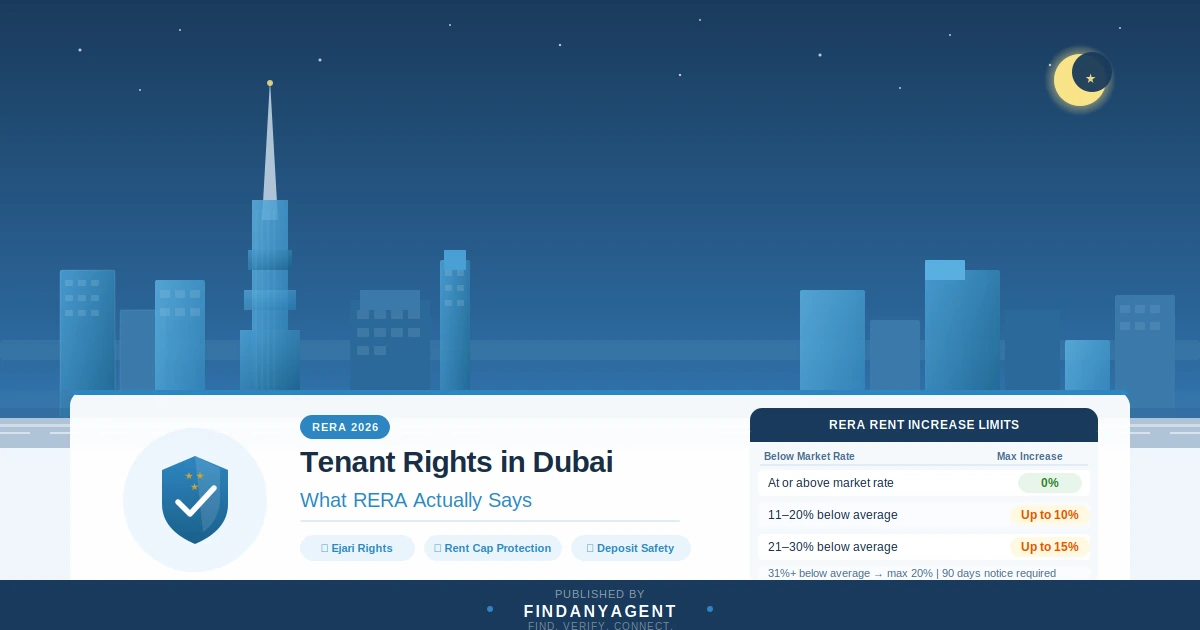
This is where most tenant disputes happen — and where most tenants don’t realize how much protection they actually have. Rent increases in Dubai are not left to negotiation or market pressure. They’re governed by the RERA Rental Index (upgraded in 2026 to a more precise, building-level “Smart Rental Index” using real-time Ejari data).
The rule works like this: your landlord compares your current rent to the index average for your specific building and unit type. The permitted increase depends on how far below that average your rent currently sits:
| How far below market average | Maximum allowed increase |
|---|---|
| At or above market rate | 0% (no increase allowed) |
| 11–20% below average | Up to 10% |
| 21–30% below average | Up to 15% |
| 31% or more below average | Up to 20% |
Two more things to know:
- Your landlord must give you 90 days’ written notice before any rent increase takes effect at renewal.
- If they fail to give proper notice, you’re entitled to renew at your existing rent.
Before agreeing to any increase, check the official RERA Rent Calculator on the Dubai Land Department’s website using your Ejari contract number — it takes a few minutes and tells you exactly what’s legally permitted.
3. Your Security Deposit Is Protected
- The standard deposit is capped at 5% of annual rent for unfurnished properties and 10% for furnished ones.
- Your landlord must return it within 30 days of you vacating.
- Deductions are only allowed for genuine damage beyond normal wear and tear — not for general “refurbishment” or cosmetic preferences.
Tip: do a documented move-in and move-out inspection with photos. This is the single most useful piece of evidence in a deposit dispute.
4. Protection From Sudden or Informal Eviction
A landlord cannot simply decide you’re out. Dubai law sets out specific, limited grounds for eviction, and each comes with a defined notice period. We’ve covered the full eviction process — including notice periods, valid legal grounds, and what to do if your landlord tries to skip the process — in our companion guide: How to Legally Terminate a Tenancy Contract in Dubai.
What’s worth knowing here is simply this: self-help evictions are illegal. Your landlord cannot change the locks, cut your utilities, or otherwise pressure you out without going through the formal legal process. If this happens to you, it’s grounds for an immediate complaint to the RDC.
5. Right to Maintenance and Habitability
Structural issues and major repairs (AC systems, plumbing, electrical, structural defects) are the landlord’s responsibility unless your contract states otherwise. Day-to-day minor maintenance typically falls to the tenant. If you report a maintenance issue in writing and your landlord doesn’t act within a reasonable period, you have recourse through the RDC.
6. Right to Privacy
Your landlord cannot enter your unit without reasonable advance notice — generally understood as at least 24 hours — except in genuine emergencies.
7. Protection From Retaliation
If you file a complaint with RERA or the RDC, your landlord cannot retaliate by refusing to renew your lease or initiating eviction proceedings because of it. This protection exists specifically because tenants often hesitate to raise legitimate complaints for fear of losing their home — the law closes that loophole.
What to Do If You Believe Your Rights Have Been Violated
- Document everything — written notices, WhatsApp messages, emails, photos.
- Attempt direct resolution first — a single written communication attempting to resolve the issue is generally expected before filing a formal complaint.
- File with the RDC — via the DLD website, the Dubai REST app, or in person at the RDC office. The filing fee is typically 3.5% of your annual rent, with a minimum of AED 500.
- Track your case digitally — most straightforward cases resolve within a few weeks.
The Bottom Line
Dubai’s rental market is heavily regulated, and as a tenant you have more protection than many newcomers assume — but those protections only work if you know them and use them. Before signing a renewal, accepting a rent increase, or panicking over an eviction notice, check it against what RERA actually permits.
If you’re currently facing an eviction notice or unsure whether your landlord is following the correct process, read our detailed breakdown: How to Legally Terminate a Tenancy Contract in Dubai.
This article is for general informational purposes and does not constitute legal advice. Rental laws and RERA procedures may be updated over time — always verify current requirements via the Dubai Land Department or RERA directly, or consult a licensed legal professional for guidance specific to your situation. Looking for a trusted real estate agent to help you navigate your next lease? Browse verified agents on FindAnyAgent.