
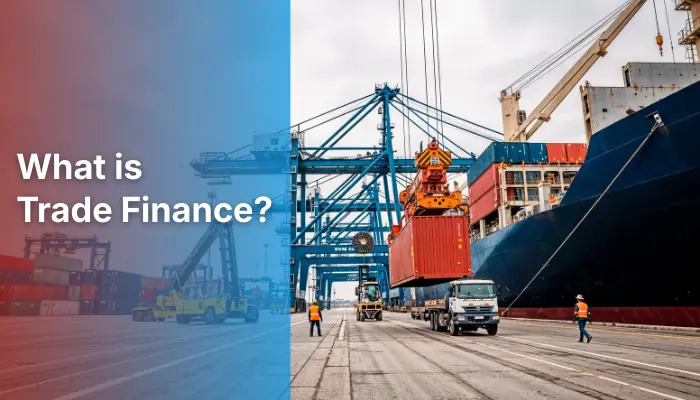
Let’s assume: A textile manufacturer in the UAE wants to export clothing to Germany. The German buyer wants to inspect the goods first. The exporter needs payment up front for production costs.
Who takes the risk? This is where trade finance helps.
Trade finance bridges the gap in international commerce. It makes global trade possible. Between 80-90% of world trade relies on trade finance. It provides tools and guarantees that reduce risk. It keeps global commerce flowing smoothly.
So, let’s discuss in this blog what is trade finance, how it works, key players, different product types, and why it matters for your business. Let’s discuss!
What is Trade Finance, With Examples
Trade finance refers to financial arrangements that help buyers and sellers trade safely. It ensures exporters get paid. It guarantees that importers receive their goods.
The system includes financial instruments, banking products, and insurance solutions. These tools facilitate cross-border exchange of goods and services.
Please note: Understanding trade finance also requires awareness of broader business regulations, and you can explore this further by reviewing the understanding of UAE corporate tax rules.
Why is it needed?
Buyers and sellers in different countries often don’t trust each other. They face risks like currency fluctuations, political instability, and payment delays. This is why understanding what is trade finance also requires knowing why it exists: to solve trust issues and protect both sides.
Real-World Example 1 of Trade Finance: Letter of Credit for Electronics
Scenario: A UK retailer wants to import 1,000 smartphones worth $50,000 from China.
Problem: The Chinese supplier won’t ship without payment. The UK buyer won’t pay without receiving goods.
Solution: The UK retailer’s bank issues a letter of credit. This guarantees payment once shipping documents are presented. The supplier ships confidently. The retailer pays after document verification.
Outcome: Both parties are protected. The transaction proceeds smoothly.
Real-World Example 2 of Trade Finance: Invoice Financing for Coffee
Scenario: A Colombian coffee exporter sells $100,000 worth of beans to a US buyer. Payment terms are 90 days.
Problem: The exporter needs immediate cash to pay farmers. But they must wait three months for payment.
Solution: The exporter uses invoice financing. They sell the unpaid invoice to a finance provider for $95,000 upfront. The provider collects $100,000 from the buyer after 90 days.
Outcome: The exporter maintains a healthy cash flow. Farmers get paid on time. The US buyer keeps favorable payment terms.
Trade Finance Products Explained
Understanding what is trade finance also means knowing the tools used in it. These are its most common tools:
Letters of Credit (LC)
The most widely used trade finance instrument. LCs provide payment guarantees from banks.
When a seller presents complying documents, the bank must pay. This happens regardless of the buyer’s situation.
Types include:
- Sight LCs (immediate payment)
- Usance LCs (deferred payment)
- Confirmed LCs (additional bank guarantee)
- Revolving LCs (for ongoing relationships)
Bank Guarantees
Written commitments from banks to pay beneficiaries if applicants fail to perform.
Common types:
- Bid bonds (guaranteeing tender participation)
- Performance bonds (ensuring contract completion)
- Advance payment guarantees (protecting prepayments)
- Financial guarantees (supporting credit obligations)
Documentary Collections
Less expensive than LCs. Banks act as intermediaries to exchange documents for payment.
Types:
- Documents against Payment (D/P) requiring immediate payment
- Documents against Acceptance (D/A) allowing deferred payment
Trade Credit Insurance
Protects exporters against buyer non-payment. Coverage includes insolvency, protracted default, or political events.
Insurance enables sellers to offer competitive credit terms while maintaining security.
Supply Chain Finance (SCF)
The largest segment in trade finance. It allows companies to extend payment durations. Suppliers get early payment options.
Buyers with strong credit enable suppliers to access early payment at favorable rates.
Invoice Financing and Factoring
Exporters sell unpaid invoices to finance providers at a discount. They receive immediate cash.
Factoring typically includes collection services. Invoice financing simply advances funds against receivables.
Forfaiting
The purchase of medium to long-term receivables without recourse. Typically used for capital goods or large projects.
Forfaiters assume all risks associated with payment collection.
4 Key Parties Involved in Trade Finance
Four key players participate in trade finance:
- Exporters (Sellers): Businesses shipping goods internationally. They seek payment assurance and often need financing between production and payment.
- Importers (Buyers): Companies purchasing from foreign suppliers. They want to verify quality and quantity before payment.
- Banks and Financial Institutions: Act as intermediaries. They issue letters of credit, provide guarantees, and facilitate payments through SWIFT. Banks held over 70% market share in trade finance during 2024.
- Insurance Companies: Provide trade credit insurance. This protects exporters against non-payment due to buyer insolvency or political instability.
What are the 3 Major Risks of Trade Finance?
Knowing what is trade finance only covers half the picture. You must also know the risks associated with it. Recognizing the following risks helps you choose appropriate solutions.
Payment Risk
Payment risk is the biggest concern in cross-border trade.
- Non-payment risk: Buyers may refuse or be unable to pay. This happens due to financial difficulties, bankruptcy, or quality disputes.
- Delayed payment risk: Even creditworthy buyers might delay payments. Reasons include bureaucratic processes or cash flow challenges.
- Currency fluctuation risk: Exchange rate movements between order and payment can impact profitability for both parties.
Letters of credit and trade credit insurance address these payment risks directly.
Country Risk
Operating across borders introduces location-specific risks:
- Political risk: Government instability or regime changes can disrupt transactions. Expropriation or nationalization may prevent payment.
- Transfer risk: Foreign exchange controls can prevent buyers from transferring payments internationally.
- Regulatory risk: Changing import/export regulations or tariffs can suddenly impact trade viability.
- Economic sanctions: International sanctions can abruptly halt trade with specific countries.
According to Protiviti, during 2024, banks dealt with increasingly complex sanctions environments. This particularly affected trade with Russia and Iran.
Corporate Risk
Risks related to the trading parties themselves include:
- Credit risk: The counterparty’s financial health may deteriorate. This affects their ability to fulfill obligations.
- Performance risk: Sellers may fail to deliver goods meeting specifications. Buyers may unreasonably reject conforming goods.
- Documentation risk: Errors in trade documents can delay payments or create disputes.
- Fraud risk: Forged documents or misrepresented goods pose threats when trading with unfamiliar parties.
Why Does Trade Finance Exist? 5 Potential Reasons
Trade finance solves fundamental challenges in international commerce.
- Trust Gap: Buyers and sellers in different countries often have no prior relationship. Without trust, neither party wants to take the first step.
- Cash Flow Management: International transactions involve long timeframes. Exporters need months to manufacture. Shipping takes weeks. Payment terms extend further. Trade finance provides working capital during these delays.
- Risk Mitigation: Cross-border business involves numerous risks. Trade finance instruments transfer these risks to banks and insurers, better equipped to manage them.
- Market Access: Small and medium-sized enterprises often lack the financial strength for international trade. Trade finance levels the playing field. It gives smaller businesses access to global markets.
- Economic Development: Trade finance supports economic growth and job creation. This is particularly true in developing economies, where the SME lending gap reached $2.6 trillion in 2023.
Trade finance exists because the benefits of global commerce outweigh the costs when proper risk tools are available.
How Does Trade Finance Work? 6-Step Process
Trade finance operates through structured processes. Multiple parties coordinate to ensure smooth transactions.
Step 1: Agreement and Contract
Buyer and seller agree on terms. These include goods specifications, quantity, price, payment method, and delivery schedule. They decide which trade finance instrument suits their needs.
Step 2: Application and Issuance
For bank-intermediated products, the buyer applies to their bank. The bank assesses creditworthiness and issues the instrument to the seller’s bank.
Step 3: Shipment and Documentation
The seller manufactures and ships goods per contract terms. They prepare required documents like commercial invoices, bills of lading, and certificates of origin.
Step 4: Document Presentation and Verification
The seller presents documents to their bank. The bank reviews them for compliance. Banks examine documents carefully, not the physical goods.
Step 5: Payment Processing
Once documents comply with the terms, the issuing bank releases payment. The seller’s bank credits the seller’s account. The buyer receives documents to claim goods.
Step 6: Goods Delivery and Completion
The buyer uses shipping documents to collect goods from customs. Upon satisfactory receipt, the transaction concludes.
Throughout this process, banks act as neutral intermediaries. This ensures neither party bears undue risk.
What is the Global Trade Certificate (GTC)
The International Chamber of Commerce offers the Global Trade Certificate. This provides comprehensive training in trade finance principles.
The GTC covers letters of credit, documentary collections, bank guarantees, and supply chain finance. It’s valuable for anyone working in international trade operations.
3 Types of Trade Finance Solutions
Trade finance provides a comprehensive range of solutions. Each is tailored to different business needs.
Settlement and Risk Mitigation Solutions
These prioritize payment assurance and risk reduction:
- Letters of Credit (Documentary Credits)
- Standby Letters of Credit
- Bank Guarantees (Performance, Bid, Advance Payment)
- Documentary Collections
- Trade Credit Insurance
Finance-Driven Solutions
These primarily address working capital needs:
- Invoice Financing and Factoring
- Supply Chain Finance (SCF)
- Purchase Order Financing
- Inventory Financing
- Pre-shipment and Post-shipment Financing
- Forfaiting (discounting receivables without recourse)
Structured Finance Solutions
For larger or more complex transactions:
- Structured Commodity Finance
- Project Finance with Trade Components
- Syndicated Trade Facilities
- Export Credit Agency (ECA) Backed Finance
Your choice depends on factors such as transaction size, counterparty relationships, risk profile, and financing needs.
Benefits of Trade Finance
Trade finance delivers substantial advantages for all parties.
| Stakeholder | Key Benefits |
| Exporters (Sellers) | • Access funds immediately without waiting for payments
• Bank guarantees protect against non-payment • Offer competitive credit terms to win more deals • Enter new markets and trade with unfamiliar buyers |
| Importers (Buyers) | • Pay only after goods are verified and shipped
• Receive and resell goods before paying suppliers • Strengthen supplier relationships with prompt payments • Fulfill large orders beyond immediate capacity |
| Banks & Financial Institutions | • Generate fees and interest with low default rates
• Deepen client relationships and increase loyalty • Cross-sell treasury, FX, and cash management services |
| Global Economy | • Powers 80% of global trade transactions
• Gives SMEs access to international markets • Creates jobs throughout global supply chains |
What Challenges Does Trade Finance Face?
Despite benefits, trade finance faces several challenges.
| Challenge | Summary |
| Cost Considerations | Multiple fees (issuance, advising, amendments, insurance). High costs reduce profitability for small transactions. |
| Documentation Complexity | Strict document checks mean even small errors cause delays or rejections. Requires expertise and accuracy. |
| Processing Time | Involves several parties, leading to slow processing. Transactions may take days or weeks, affecting urgent shipments. |
| Limited Bank Participation | Not all banks provide full trade finance services, especially for SMEs. Low risk appetite restricts access. |
| Regulatory Compliance | AML, KYC, and sanctions rules add cost and time. Banks must verify all parties, which slows processing. |
| Trade Finance Gap | The global gap of $2.5 trillion limits financing availability, especially for SMEs in developing countries. ( International Finance Corporation) |
| Fraud Risk | Risks include forged documents and misrepresented goods. Banks increase verification to reduce fraud, but vigilance is needed. |
The Future of Trade Finance
The trade finance industry is experiencing a significant transformation.
Digital Transformation and Blockchain
Blockchain technology promises to reorganize trade finance. It creates immutable, transparent digital records. This reduces fraud and eliminates paper documentation.
Several blockchain platforms already facilitate transactions. Major banks participate in pilot programs.
Artificial Intelligence and Machine Learning
AI applications are transforming risk assessment and fraud detection. They automate document verification and improve credit decisions.
Machine learning analyzes vast datasets to identify patterns. This assesses counterparty risk more accurately.
Central Bank Digital Currencies (CBDCs)
Many countries are exploring or implementing CBDCs. These could streamline cross–border settlements and reduce transaction costs.
Brazil has advanced its CBDC pilot program. It focuses on trade finance for agricultural commodities.
Sustainability and ESG Integration
Environmental, Social, and Governance factors increasingly influence trade finance decisions.
Green trade finance products reward sustainable practices. Banks incorporate ESG criteria into lending decisions.
Alternative Finance Providers
Fintech companies and non-bank lenders are entering the trade finance market. They offer innovative solutions targeting underserved SMEs.
These platforms leverage technology to reduce costs and provide faster approvals.
What is Trade Finance: FAQs
What are the Four Pillars of Trade Finance?
- Payment and Settlement
- Risk Mitigation
- Financing and Liquidity
- Information and Documentation
What is Another Name for Trade Finance?
Trade finance is also called export-import finance or trade credit. Other terms include international trade finance or documentary credits.
Who Needs Trade Finance?
- Exporters & Importers
- Small and Medium Enterprises (SMEs)
- Manufacturers
- Commodity Traders
- Established Corporations
What is Trade Finance in Banks?
In banking, trade finance refers to specialized departments supporting clients’ international trade activities.
What is a Trade Finance Loan?
A trade finance loan is short-term financing for specific international trade transactions. Examples include pre-shipment loans and post-shipment loans that bridge payment gaps.
What is Trade Finance in Economics?
From an economic perspective, trade finance serves as a critical infrastructure for international commerce and growth. It addresses market failures that would prevent efficient global trade:
The Bottom Line
Understanding what is trade finance gives businesses a strong advantage in global markets. It reduces risk, improves cash flow, and creates trust between buyers and sellers. With digital innovation accelerating, trade finance is becoming faster, safer, and more accessible.
Whether you’re an importer or an exporter, the right trade finance solution can help you grow confidently across borders.