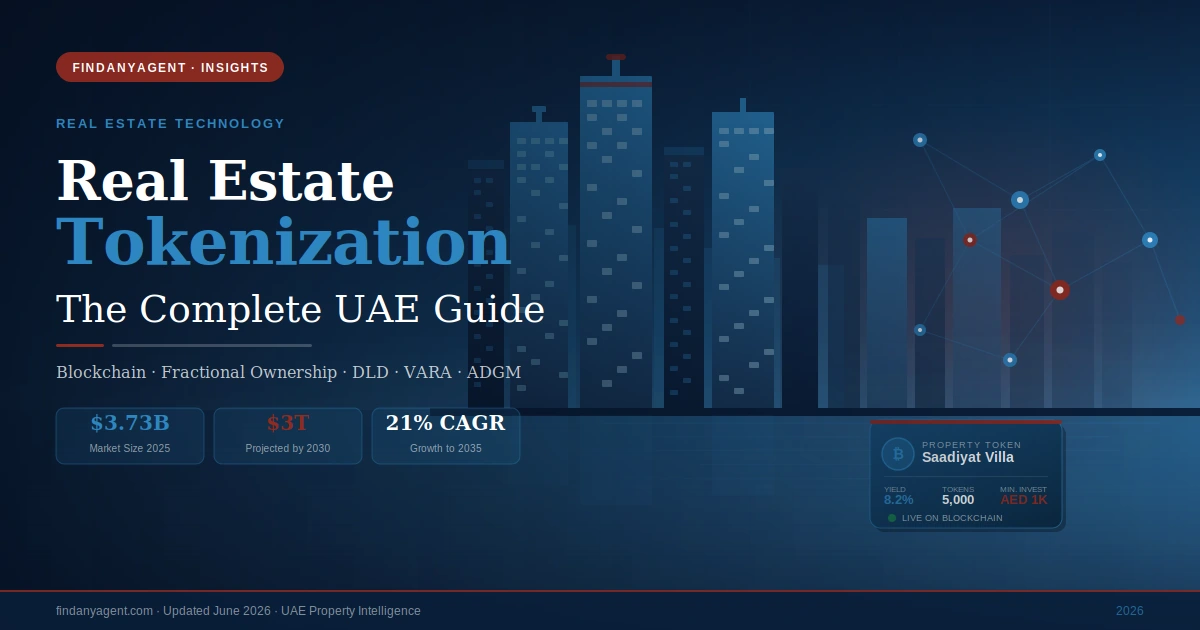
Imagine owning a slice of a Saadiyat Island villa for AED 1,000. Or earning rental income from a Yas Island apartment automatically deposited into your digital wallet every month — without tenants, agents, or paperwork. That is not a distant future. It is happening right now in the UAE, and it is called real estate tokenization.
In February 2026, Dubai became one of the first cities in the world to launch a regulated secondary market for tokenized real estate, allowing investors to buy and sell fractional property stakes as freely as trading stocks. Abu Dhabi followed with its own regulatory framework through ADGM, positioning the UAE as the global capital of tokenized property investment.
For the millions of people who have always wanted to invest in UAE real estate but were locked out by high prices, illiquidity, or complex ownership structures, tokenization is a fundamental shift in access. This guide explains everything: what it is, how it works, how it is regulated in the UAE, how to invest, and what the risks are.
1. What Is Real Estate Tokenization?
Real estate tokenization is the process of representing ownership in a physical property as digital tokens on a blockchain. Each token is a programmable digital certificate that grants its holder a proportional stake in the underlying asset — its value, its rental income, and (depending on the structure) its governance rights.
Think of it like this: a AED 5 million apartment on Al Reem Island is divided into 5,000 tokens, each worth AED 1,000. You buy 10 tokens for AED 10,000 and own 0.2% of the apartment. Every month, your 0.2% share of the rental income is automatically distributed to your digital wallet. If the property value rises to AED 6 million, your tokens are now worth AED 1,200 each.
This is not a new financial concept — fractional ownership of real estate has existed through REITs and property funds for decades. What tokenization adds is blockchain infrastructure that makes the process faster, cheaper, more transparent, and genuinely global.
What gives a token its value?
A token’s value derives entirely from the underlying real estate asset. Unlike cryptocurrencies such as Bitcoin, real estate tokens are not speculative digital currencies — they are security tokens, regulated financial instruments backed by a tangible asset with verifiable income and market value. The token is only as valuable as the property it represents.
What does a token actually represent legally?
This is where it gets nuanced. In most tokenization structures, you do not hold a direct deed to a fraction of the property. Instead, you hold tokens that represent membership shares in a Special Purpose Vehicle (SPV) — a legal entity (typically an LLC) that owns the property. Your tokens represent your equity in the SPV, which in turn owns the asset. This legal wrapper is what makes tokenization enforceable in regulated jurisdictions like the UAE.
2. How Real Estate Tokenization Works — Step by Step
Tokenizing a property involves a coordinated process across legal, technical, and financial disciplines. Here is how a typical tokenization unfolds from asset to investor:
The property is selected — typically one with stable, predictable rental income such as a residential apartment, commercial unit, or hospitality asset. An independent valuation is conducted and documented. Properties with clear title, no encumbrances, and strong rental demand make the best candidates.
The property is placed into a Special Purpose Vehicle — a legally registered entity created solely to hold and manage this one asset. The SPV isolates the property from the issuer’s balance sheet, protecting investors from the issuer’s other financial risks. In the UAE, SPVs are commonly structured under ADGM or DIFC free zone law for regulatory clarity.
Digital tokens are designed to represent fractional shares in the SPV. Smart contracts — self-executing code on the blockchain — are written to govern everything automatically: how many tokens exist, how rental income is distributed, what transfer restrictions apply (for compliance), and how governance votes are conducted. Token standards such as ERC-1400 or ERC-3643 are used because they include built-in compliance and restriction logic required for regulated securities.
The token offering must be approved by the relevant regulator — VARA in Dubai, FSRA in ADGM, or DFSA in DIFC. Before any investor can purchase tokens, they must pass Know Your Customer (KYC) identity verification and Anti-Money Laundering (AML) screening. This is encoded directly into the smart contract, preventing non-compliant wallets from holding tokens.
Tokens are minted on the blockchain and made available to verified investors through a licensed tokenization platform. Investors purchase tokens, funds are collected into the SPV, and the token transaction is immutably recorded on the blockchain — creating a permanent, tamper-proof ownership record.
The property is professionally managed. Rental income collected from tenants is converted (often into a stablecoin such as USDC) and distributed automatically to token holders via smart contract — proportional to their holdings, on a monthly or quarterly schedule, with no manual processing required.
Token holders can sell their tokens to other investors on a licensed secondary marketplace — 24 hours a day, unlike traditional real estate which can take 30–60 days to sell. Settlement is near-instant (T+0 or T+1) versus weeks for conventional property transactions. In Dubai, DLD-regulated secondary market trading went live in February 2026.
3. Real Estate Tokenization in the UAE — Regulations and Landscape
The UAE has emerged as one of the most progressive jurisdictions globally for real estate tokenization, with multiple overlapping regulatory frameworks that together create a comprehensive — if complex — legal environment for issuers and investors.
Dubai: DLD + VARA Pilot Programme
In early 2025, the Dubai Land Department (DLD) launched a landmark tokenization pilot in partnership with the Virtual Assets Regulatory Authority (VARA), Dubai Future Foundation, and the Central Bank of the UAE. The pilot produced a concrete proof of concept: Dubai’s first tokenized property was sold in under 24 hours, attracting 224 investors from 40 countries at an average investment of AED 10,714.
The infrastructure behind the pilot included Prypco Mint (a VARA-regulated broker-dealer), Ctrl Alt (blockchain infrastructure on the XRP Ledger), and Zand Bank (UAE’s first fully digital bank). Critically, tokenized title deeds were recorded directly on the DLD’s official land registry — giving them the same legal standing as conventional property ownership. Secondary market trading went live on 20 February 2026, allowing investors to resell their tokenized stakes on a regulated marketplace.
Abu Dhabi: ADGM’s FSRA Framework
In Abu Dhabi, the Abu Dhabi Global Market (ADGM) and its Financial Services Regulatory Authority (FSRA) have positioned the emirate as an institutional-grade home for tokenized assets. ADGM introduced a DLT Foundations regime specifically designed for token issuance and on-chain organisational structures — providing legal certainty for SPVs operating on blockchain. In June 2025, FSRA issued updated digital asset guidance that streamlined licensing and reduced capital requirements, making ADGM more accessible to institutional issuers.
Federal Level: SCA and Central Bank
At the federal level, the Securities and Commodities Authority (SCA) governs tokenized securities across the UAE. Tokenized real estate is most commonly classified as a security token (representing equity in an SPV), which places it squarely within the SCA’s regulatory perimeter. The Central Bank of the UAE oversees AML and CFT compliance across all digital asset transactions, with its Payment Token Services Regulation (PTSR 2024) governing asset-referenced tokens.
| Regulator | Jurisdiction | Role in Tokenization | Key Framework |
|---|---|---|---|
| VARA | Dubai | Licenses broker-dealers and trading platforms for tokenized assets | VARA Virtual Assets Regulation 2023 |
| DLD | Dubai | Records tokenized title deeds on official land registry | DLD Tokenization Pilot 2025–26 |
| ADGM FSRA | Abu Dhabi | Regulates digital asset issuance, SPVs, and token trading | DLT Foundations Regime; FSRA Digital Assets Framework 2025 |
| DFSA | DIFC, Dubai | Governs digital securities, SPVs, and crowdfunding in DIFC | DFSA Digital Securities Regime |
| SCA | Federal | Governs token offerings classified as securities across all emirates | SCA Decision No. 23/R.M of 2020 |
| Central Bank UAE | Federal | AML/CFT compliance; governs asset-referenced payment tokens | PTSR 2024 |
4. Benefits of Tokenized Real Estate for Investors
Fractional Ownership — Lower Entry Barrier
The most transformative benefit is access. A AED 3 million property on Yas Island has historically required either a full purchase or a REIT investment that pools your money with dozens of other assets. Tokenization lets you invest in that specific property for AED 1,000–5,000 — the exact asset you want, in the community you understand, at a price point that doesn’t require a mortgage.
Liquidity — Sell When You Need To
Traditional real estate is one of the most illiquid asset classes that exists. Selling a property in Abu Dhabi typically takes 30–90 days, involves agents, transfer fees, NOCs, and extensive documentation. Tokenized real estate can be sold on a secondary marketplace in minutes, with near-instant settlement. This fundamentally changes the risk profile of property investment — you are never truly locked in.
Passive Income — Automated Rental Distribution
Smart contracts distribute your share of rental income automatically, directly to your digital wallet, on a programmed schedule. No chasing landlords, no management delays, no bank transfer fees. For investors who want genuine passive income from real estate without the operational burden of being a landlord, this is significant.
Transparency — Immutable Blockchain Records
Every ownership transfer, every income distribution, every governance vote is recorded permanently on the blockchain — visible to all token holders. This level of transparency is impossible in traditional real estate, where transactions are often opaque and settlement records are scattered across registries, notaries, and banks.
Global Access — Invest from Anywhere
A qualified investor in London, Singapore, or New York can invest in a tokenized Abu Dhabi property without flying in, opening a local bank account, or navigating foreign ownership regulations — as long as the platform’s KYC/AML process is completed. This dramatically expands the pool of capital available to UAE real estate.
Portfolio Diversification
Because the entry threshold is low, investors can spread AED 50,000 across five different properties — a villa on Saadiyat, an apartment on Al Reem, a commercial unit in the ADGM financial district — rather than concentrating all capital in one asset. Diversification across communities, asset types, and risk profiles is now accessible to retail investors, not just institutional funds.
5. Risks and Limitations — What You Need to Know
✔ Opportunities
- Access to UAE’s high-yield property market from AED 1,000+
- Automated rental income via smart contract
- Liquid secondary market (Dubai, from Feb 2026)
- Regulated by VARA, ADGM, DLD
- Global investor access
- Transparent on-chain records
- Diversification across multiple properties
✘ Risks
- Secondary market is early-stage — liquidity may be thin
- Regulatory complexity across multiple UAE bodies
- Smart contract bugs or platform failure risk
- No direct physical ownership of the deed
- Rental income not guaranteed — tied to occupancy
- Token value tied to property market fluctuations
- Currently limited to UAE ID holders on DLD pilot
Regulatory Risk
The UAE’s tokenization regulatory framework, while progressive, is still evolving. Rules can change, platforms can lose licences, and frameworks across VARA, ADGM, DFSA, and SCA are not fully harmonised. Before investing, verify that your chosen platform holds a current, valid licence from the relevant UAE authority.
Platform and Counterparty Risk
You are not buying property directly — you are buying tokens issued by an SPV managed by a platform. If the platform ceases operations, you need clear legal recourse. Always check whether the SPV is structured to protect investor assets in the event of issuer insolvency, and whether an independent custodian holds the property title.
Liquidity Risk
While tokenization dramatically improves liquidity versus direct property ownership, secondary markets for real estate tokens are still young. Trading volumes may be low for specific assets, meaning you could struggle to sell at fair value quickly — particularly during broader market downturns.
Technology Risk
Smart contracts are code, and code can have bugs. A vulnerability in a smart contract governing a tokenized property could be exploited by malicious actors. Reputable platforms conduct independent security audits, but this risk never reaches zero.
6. Tokenization vs REITs vs Direct Ownership
| Feature | Direct Ownership | REIT | Tokenized Real Estate |
|---|---|---|---|
| Min. Investment | AED 500,000+ | AED 1,000+ (listed) | AED 500–5,000 |
| Asset Control | Full — you choose the asset | None — fund manager decides | Partial — you choose the asset |
| Liquidity | Very low — weeks/months to sell | High — listed on stock exchange | Medium-high — secondary market |
| Income Distribution | Manual — via bank transfer | Quarterly dividend | Automated — via smart contract |
| Transparency | Medium — via land registry | Medium — quarterly reports | High — on-chain record |
| Diversification | Low — one asset per purchase | High — fund holds many properties | Medium — one asset per token, but scalable |
| Fees | High — transfer, agent, DLD fees | Management fees (1–2% p.a.) | Platform fees (typically 0.5–1.5%) |
| Settlement Time | 30–60 days | T+2 (exchange) | T+0 to T+1 |
| UAE Regulation | ADREC / DLD / ADREC | SCA / ADX / DFM | VARA / ADGM / DLD / SCA |
The honest answer is that tokenized real estate occupies a genuinely different niche to both REITs and direct ownership. It gives you the asset specificity of direct ownership (you choose exactly which property) with the low entry cost and liquidity of REITs — but with lower diversification than a REIT fund and less security than a full freehold title. For investors who want to participate in the UAE property market with limited capital and maximum flexibility, it is a compelling middle path.
7. How to Invest in Tokenized Property in the UAE
Step 1 — Choose a Licensed Platform
Only invest through platforms that hold a valid licence from a UAE regulatory authority. Current key players in the UAE tokenized real estate space include:
- Prypco Mint — VARA-regulated broker-dealer; central to DLD’s tokenization pilot in Dubai
- SmartCrowd — DFSA-regulated Dubai-based fractional property platform
- Stake — DFSA-regulated; one of the UAE’s most active fractional real estate platforms
- Huspy / Equitymultiple equivalents — emerging platforms with ADGM licensing pathways
Always verify licence status directly on the relevant regulator’s website (VARA: vara.ae; DFSA: dfsa.ae; ADGM FSRA: fsra.adgm.com) before depositing funds.
Step 2 — Complete KYC/AML Verification
All licensed platforms require identity verification before you can invest. This typically involves uploading a government-issued ID (Emirates ID for UAE residents; passport for international investors where permitted), proof of address, and a source of funds declaration. Processing typically takes 1–3 business days.
Step 3 — Browse and Evaluate Properties
Once verified, you can browse available tokenized properties. Key metrics to review for each asset:
- Gross rental yield — annual rent as a percentage of property value (UAE average: 5–8%; Al Reef can exceed 10%)
- Occupancy rate — higher is better; below 80% is a concern
- Property type and location — established communities (Al Reem, Yas, Saadiyat) carry lower vacancy risk
- Token price and total supply — understand your fractional stake
- SPV structure — confirm the legal entity, jurisdiction, and custodian
- Exit mechanism — how and when can you sell your tokens?
Step 4 — Invest and Hold Tokens
Purchase your desired number of tokens through the platform. Your ownership is recorded on the blockchain immediately. You will begin receiving your proportional share of rental income on the platform’s distribution schedule — typically monthly.
Step 5 — Monitor and Trade
Track your portfolio performance via the platform dashboard. If and when you want to exit, list your tokens on the secondary marketplace. Token prices may trade at a premium or discount to the underlying property value depending on supply and demand dynamics in the marketplace.
8. The Future of Tokenized Property Investment
We are at the very beginning of real estate tokenization’s growth curve. Roland Berger evaluated the market for tokenized real estate at $119 billion in 2023 and predicted it would reach $3 trillion by 2030 at a CAGR of 60%. The real estate tokenization market is predicted to reach USD 23.99 billion by 2035 at a 21% CAGR. These projections reflect not just technology adoption, but a fundamental structural shift in how global capital flows into property.
Several converging trends will shape the next five years:
Institutional Adoption is Accelerating
In early 2025, 86% of surveyed institutional investors had exposure to, or intended to allocate to, digital assets. High-net-worth individuals and institutional investors plan to allocate 8.6% and 5.6% of their portfolios, respectively, to tokenized assets by 2026. When institutional capital — pension funds, sovereign wealth funds, family offices — flows into tokenized real estate at scale, liquidity and price discovery in secondary markets will improve dramatically.
DeFi Integration
The next frontier is integrating tokenized real estate with decentralised finance (DeFi) protocols — allowing token holders to use their property tokens as collateral for loans, or to participate in yield-generating liquidity pools. This would unlock a level of capital efficiency impossible in traditional property markets.
AI-Powered Property Selection
AI tools are increasingly being used to analyse tokenized property data — rental yield trends, occupancy patterns, neighbourhood growth indicators — to help investors make more informed token selection decisions. Platforms that combine tokenization infrastructure with AI-driven investment analytics will have a significant edge.
UAE as the Global Tokenization Hub
In Abu Dhabi, ADGM has been explicit about positioning itself as a comprehensive regulatory home for digital assets, introducing a DLT Foundations regime designed for token issuance and on-chain organisational structures. In Dubai, the Dubai Land Department is running a controlled pilot that explicitly tests governance, investor protection, and operational readiness while enabling secondary-market resale from 20 February 2026. With regulatory infrastructure, dry powder from sovereign wealth, and a globally connected investor base, the UAE is uniquely positioned to become the world’s leading marketplace for tokenized real estate.
9. Frequently Asked Questions
What is real estate tokenization?
Real estate tokenization is the process of converting ownership rights in a physical property into digital tokens on a blockchain. Each token represents a fractional share of the property, allowing multiple investors to own a portion of a single asset — similar to shares in a company, but backed by real estate.
Is real estate tokenization legal in the UAE?
Yes. Real estate tokenization is legal and actively regulated in the UAE. In Dubai, the DLD launched a tokenization pilot with VARA, the Central Bank of the UAE, and Dubai Future Foundation, with secondary market trading live from February 2026. In Abu Dhabi, ADGM’s FSRA provides a regulated framework for digital asset issuance. The SCA governs tokenized securities at the federal level.
How much money do I need to invest in a tokenized property?
Minimum investment thresholds vary by platform, but tokenization is specifically designed to lower the entry barrier significantly. Some platforms allow investments from as little as AED 500–2,000. Dubai’s first tokenized property attracted 224 investors from 40 countries with an average investment of AED 10,714 — a fraction of the cost of direct property ownership.
What returns can I expect from tokenized real estate?
Returns come from two sources: rental yield (distributed automatically via smart contract, typically 5–10% per year in Abu Dhabi) and capital appreciation if the underlying property increases in value. Returns are not guaranteed and depend on the specific property, location, occupancy rates, and market conditions.
What is the difference between tokenized real estate and a REIT?
REITs pool money into a managed fund that invests in many properties. Tokenized real estate lets you invest in a specific property of your choice, with ownership recorded directly on the blockchain. Tokenization offers more asset control, transparency, lower fees, faster settlement, and 24/7 trading — but with less built-in diversification than a REIT fund.
Can foreigners invest in tokenized real estate in the UAE?
The DLD pilot currently requires a UAE ID, which is open to all nationalities holding one. Expansion to international investors without a UAE ID is planned. ADGM-regulated platforms may have different eligibility criteria. Always check the specific platform’s requirements before investing.
What happens if the tokenization platform shuts down?
This depends on the legal structure. In a well-structured tokenization, the property is held by an independent SPV — meaning even if the platform operator closes, the SPV continues to exist and investors retain their ownership rights. Always verify the SPV structure, custodian arrangements, and wind-down provisions before investing on any platform.
Do I pay tax on tokenized real estate income in the UAE?
The UAE has no personal income tax, which means UAE residents typically have no personal tax liability on rental income from tokenized properties. Corporate tax and VAT rules may apply depending on your structure and the token type. Investors from other countries should consult a tax advisor regarding their home country’s treatment of tokenized asset income.
Looking to Invest in UAE Property?
Browse ADREC-licensed agents across Abu Dhabi and Dubai — compare by community, specialization, and verified reviews, for free.